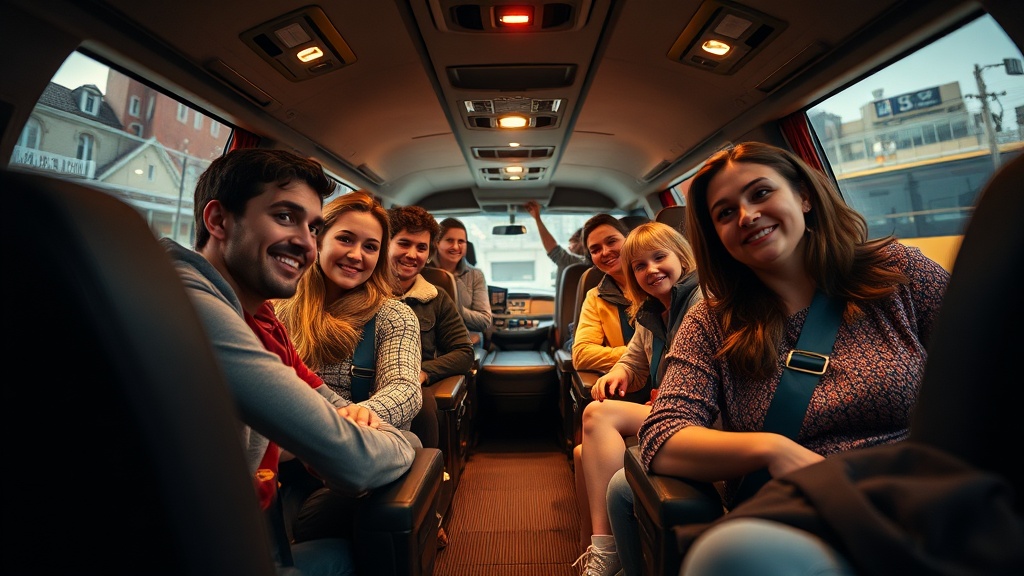
Organizing Group Transportation for Large Families and Travel Parties

Imagine standing on a curb in a foreign city, surrounded by four suitcases, a stroller, and a group of six hungry relatives, while staring at a ride-share app that says "no cars available." This isn't just a minor inconvenience; it is the moment where group travel tension peaks. Coordinating movement for a large party requires more than just picking a destination. It requires a logistical strategy that accounts for luggage, timing, and the varying physical abilities of your group members. This guide looks at how to handle the heavy lifting of transit so your group actually arrives at the destination without a hitch.
How much luggage space do we actually need?
The most common mistake in group travel is underestimating the volume of gear. If you are traveling with a family of five, you aren't just accounting for five people; you are accounting for five sets of clothes, plus strollers, diaper bags, and perhaps even a folding chair or two. A standard sedan or even a standard SUV often falls short when the group is large.
When booking transport, always check the specific luggage capacity of the vehicle class. For instance, a standard minivan might seat seven passengers, but if you have seven people and seven suitcases, you won't fit. You might need to book two separate vehicles or a high-capacity passenger van. You can check the specific baggage policies for major transit providers like Amtrak if you are traveling via rail, as their luggage allowances differ significantly from airlines or car rentals. Always assume you need one more bag than you think you do.
Should we rent a van or use ride-sharing?
Deciding between a rental vehicle and on-demand-transport depends entirely on your destination's layout. If you are visiting a rural area or a mountainous region where public transit is non-existent, a rental van is your best bet. It gives you the freedom to move on your own schedule without waiting for a driver. However, if you are staying in a dense urban center like London or Tokyo, a rental can become a liability due to parking costs and narrow streets.
In urban settings, ride-sharing or specialized car services often make more sense. Instead of trying to find a single vehicle that fits everyone, it is often faster to call two or three vehicles simultaneously. This prevents the "waiting for the last person" syndrome that kills momentum. If your group is particularly large, look into private shuttle services. These are often more reliable for large-scale movement than standard ride-share apps, which can be hit-or-miss during peak hours.
What are the best ways to keep everyone together?
Keeping a group together during transit is a psychological challenge as much as a physical one. To keep things moving, assign roles. One person should be the "Navigator" (responsible for the map and timing), and another should be the "Logistics Lead" (responsible for checking the number of bags and people before departing). This prevents the constant "Wait, did we leave someone behind?" conversation.
- The Meet-up Point Strategy: Never tell a group to "meet at the station." Instead, designate a specific pillar or a visible sign.
- The Buffer Time Rule: If the train leaves at 2:00 PM, tell the group the departure is at 1:30 PM. This accounts for the inevitable slow walker or the person who forgot their water bottle.
- Digital Check-ins: Use a group chat for real-time updates, but don't rely on it for critical-path instructions.
When planning, look at the topographical layout of your destination. If you are visiting a place with steep hills or cobblestone streets, even a short walk from a drop-off point can be grueling for older family members or those with small children. Always check the walkability of the area around your transit hubs. A highly-rated station is useless if there is a half-mile trek to the actual hotel entrance.
One often overlooked factor is the cost-per-person. While a private van rental might seem expensive upfront, it is frequently cheaper than calling three separate taxis every time the group wants to go to dinner. If you are staying in a single location for a week or more, the math usually favors a rental. If you are moving every two days, stick to the flexibility of local transport.
For those traveling by air, the transition from the airport to your first accommodation is the most vulnerable time for a group. Most people arrive at the airport tired, stressed, and slightly disoriented. Pre-booking an airport transfer is a way to remove that friction. Services like Viator offer various group excursions and transfers that can be booked in advance, ensuring a driver is waiting with a sign rather than you wandering around a crowded terminal looking for a taxi stand.
Lastly, consider the "comfort threshold." If you are in a group of ten, you cannot expect everyone to be able to sit in a single vehicle for four hours. Breaking the group into smaller units for certain legs of the trip can actually improve the overall mood. If the younger crowd wants to take the train and see the sights, and the older members want a private car, let them. Forcing a singular movement pattern on a diverse group often leads to frustration.